
Subscribe via E-mail

Your email:

Learn How to Get More Results from Webcasts

Discover tips, insights, best practices and additional resources to attract the most viewers and get the most return from sponsorships.

Download-Free-Webcast-Strategy-Guide

Follow Me

Adrenaline Garage Blog

Current Articles | RSS Feed RSS Feed

Do I need an iPhone strategy for my webcast?


In case you haven't noticed, the iPhone is hot.  Almost as hot are other mobile devices like Android phones and tablets, iPads and iPods, which begs a good question:

Since everyone (or 35% of us, but who's counting?) now has a mobile device, do I need to invest in a mobile device strategy for my live webcast?

Technology is a tool, not a solution

Before I answer that question, I want to take a step back.  I believe that technology is a tool. Tools are not always universally suitable.  A hammer isn't very useful when you need a saw. Likewise, some technologies might be required in one situation, but are useless in another. Before one considers whether they need to include a technology in their live online broadcast strategy, they should first ask, what am I trying to achieve?

iPhones can do live streaming, but is it worth it?

As I've stated before, we believe that in order to generate the most value from your webcast, you need to focus on maximizing the total number of minutes that viewers watch your live broadcast.  The more minutes viewers watch, the more impressions the webcast generates and the more value your broadcast has to advertisers and sponsors.  

Moreover, at Adrenaline Garage, we know that every event has a limited budget.  Therefore we recommend that events invest in strategies that will deliver the greatest ROI.  In this case, that means choosing options that generates the most minutes for the smallest investment.

So let's rephrase the question.  Will investing in a mobile device strategy increase the number of minutes that viewers watch my live online broadcast?  And secondly, with all the great things Adrenaline Garage is working on, does that strategy deliver the best ROI?

The answer to the first question is "Yes."  However, it might surprise you to discover that a mobile device strategy comes in dead last on our list of the Top Ten Things You Can Do Now to Get Better Results From Your Live Webcast.  Why?

The experience matters, not the technology

One of Steve Jobs' greatest insights, in my opinion, is that the end user cares more about the experience than they do about buzz words, technologies and specs.  When we talk about an iPhone strategy, what we really ought to be talking about is experiencing your event on a small screen vs. a mid-size (computer monitor) or large (TV) screen.  The fact is, watching a 3-hour event on a 3-inch screen is not a very good experience.  As a result, not a lot of people are willing to do it, no matter how much your viewers love their mobile devices.  And the numbers (and minutes watched) reflect this.

But don't take our word for it.  It turns out that other people have noticed that as content gets longer, the viewer prefers larger and larger screens.  Why?  I think it's because sitting on a couch is the most comfortable way to watch 45 minutes of video.

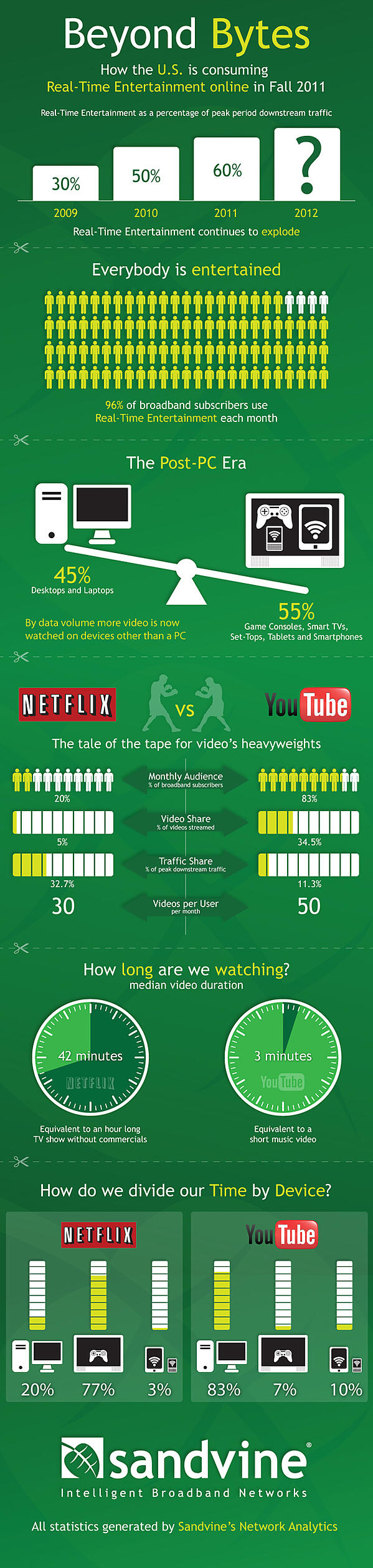
Take a look at this infographic.  Yes, yes, more and more people are watching video.  Yes, yes, they are using lots of different devices.  But let's consider the question at hand, does investing in the small screen experience deliver the best ROI?

People prefer larger screens for longer form content

Our numbers indicate that our viewers' behavior nicely parallels Netflix's viewers.  That is not surprising since live webcasts and Netflix are different types of long form content.  In fact, our average viewing time (AVT) is very similar.  The most interesting thing about this graphic is the consumption by device.  As we stated, the longer the video format, the larger the share for the larger screens.  In fact, while mobile phones and tablets represent relatively small share of YouTube viewers, they represent an even smaller share of longer form video viewers.  Like with Netflix, in our events, mobile devices represent only 2-3% of viewers.

[By the way, did you notice that longer form content represents more value than short form content in terms of traffic share (a close proxy for minutes) even while representing a smaller share of viewers?  But that's a topic for another blog post.]

Taking this one step further

This infographic hints at something else that we've noticed, which is the inverse of what we stated above.  Not only do viewers prefer larger screens for longer content, larger screens tend to encourage greater engagement on their own!  In fact, we've seen that the most engaged viewers of live webcasts tend to be the viewers watching the event on the largest screens.  While it's hard to make a direct cause and effect relationship, it would follow that you would create more value for your live broadcast by encouraging viewers to watch on larger screens rather than smaller ones.

Considering that such a small percentage of viewers use mobile devices to watch long form content, and large screen viewers are more valuable than small screen viewers, we conclude that while having a mobile device strategy would add value, it does not deliver the same ROI as investing in large screens.  

What can you do to enhance your large screen strategy?  That's a topic for another blog post. Or, if you can't wait, give us a call.

What do you think?  What's more valuable for your events, a small screen or large screen strategy?

Improve Your Webcast Results: Why Minutes matter more than Uniques


Webcast minutes = moneyPop Quiz:  Which broadcast would generate more revenue?  The one with 30,000 uniques or the one with 9,000 uniques?

The answer?  It’s a trick question.  In spite of the fact that unique views is the metric most in demand by event organizers, advertisers and producers, as a measurement of success it doesn’t reveal nearly enough information.

Advertisers and sponsors pay for impressions, the number of times their brand was exposed to a viewer.  The more impressions generated from a live broadcast, the more money they are willing to pay.

However, uniques alone doesn’t give nearly enough information about how many impressions occurred.  Unlike a webpage, uniques views is not indicative of the total impressions generated in a live broadcasts.  Throughout a viewing session, some viewers will see 3 ads, others 30 and others none.   Measuring uniques doesn’t capture any of this information.

Consider the above scenario.  It’s possible that 30,000 viewers watched for an average of 3 minutes while the 9,000 viewers watched on average for 30.  If this were the case, the second audience is actually 3 times more valuable to sponsors and advertisers because as a whole they had 3 times as long to be exposed. 

Adequately measuring the value of a live broadcast to sponsors requires a better, more comprehensive metric:  Minutes.

What is “MINUTES”?

Minutes is the total amount of time watched by all the viewers of a live broadcast.  For example, if a webcast has two viewers, John, who watches for 5 minutes, and Julie, who watches for 40 minutes, the total minutes for that webcast is 45.  In original example, we can calculate the in the first webcast to total minutes was 90,000 (30,000 viewers x 3 mins/viewer) while the second was 270,000 (9,000 viewers x 30 mins/viewer).

As you can see, the advantage of this metric is that it captures both the number of uniques and their engagement in one simple number.  Simply put, if you want to compare apples to apples, this is the metric you should be using.

MINUTES = MONEY

One of the challenges of monetizing live online broadcasts is that you have no idea exactly how many impressions your live stream’s commercials generated.  However, unlike with unique views, with minutes you can easily approximate the number of impressions that your live broadcast generates.  To do this, you need two other numbers:  Total Commercials and total broadcast running time.  If you recorded your event, simply sit down and watch it again to collect the necessary information.

Once you have those numbers, the formula is easy:

Minutes x Total Number of Ads / Total Program Running Time = Impressions

Remember, sponsors and advertisers pay for impressions.  The more impressions that your broadcast generates, them more value your live stream has.  That’s a powerful statistic that’s not available if you calculate uniques alone.

Using minutes to get more return

Growing minutes is pretty abstract, and hard to plan for.  Indeed, I think that is one of the appeals of using uniques to compare broadcasts: it’s easily understood, easy to plan for and easy to measure.  However, when you combine uniques with minutes, you can calculate another elusive but easily understood metric that will further empower you to grow your live stream:  Average Viewing Time (AVT).  While uniques tends to measure the success of your marketing and distribution strategies, AVT helps you measure the quality of your program.  The more successful your program, the longer people watch, the more ads they see and the more value you create.

You can easily calculate AVT by

 AVT = Total Minutes / Unique Viewers

Looking at all three individually, you can glean an enormous amount of information about your event.  If you have a ton of uniqes, but low engagement, then you know you need to work on creating more reasons to stay engaged.  If the opposite is true, high engagement, but low uniques, then you have an interesting event, but you need to pull in more viewers.

Since its relatively easy to create strategies focusing on either one of those goals, you can easily evaluate if your strategies are succeeding.  Overall, minutes captures both these metrics and lets you compare apples to apples.

Conclusion

Hopefully, now that you understand minutes and how you can use them to better monetize and grow your event.  If you’re interested in specific examples for how to monetize and increase minutes, check out our Live Webcast Strategy Guide.  It’s a free 20-page strategy guide filled with tips, insights, best practices and additional resources to attract the most viewers, create better engagement and get the most return from sponsorships.


Ultimate Boarder Championship Live Webcast Starts April 2, 2011


There is only one triathlon on the planet that brings together the world's best surfers, skaters and snowboarders. Don't miss the live online broadcast of the Ultimate Boarder Championship, April 2-9, 2011. 

Check it out on Facebook.  And don't forget to "Like" Adrenaline Garage while you're there.

Download our Free Live Webcast Strategy Guide


Get results from your live webcastFor action sports events, reaching hundred of thousands of viewers around the world through a live webcast promises enormous potential. Most event organizers, however, currently lack sufficient understanding of live online broadcasts to optimize and fully monetize them for their event. Without that knowledge, the return on investment, both in terms of audience and sponsorship, is not yet close to what it could be.  Lower returns have a direct effect on the long-term success of the event.

Learn how to plan a live webcast with greater returns by delivering the results sponsors crave.


In working with our partners, Adrenaline Garage has taken an interest in seeing their event properties grow.  We’ve observed that there are ways to strategically increase the value of live broadcasts and increase an event’s attractiveness to sponsors.  We collected the best practices and explored new directions in order to create a comprehensive strategy guide to accelerate our partner’s success.

Download this free live webcast strategy guide and learn:

  • What sponsors want and how a live webcast best fulfills their needs.
  • What your audience wants and why that’s important to sponsors.
  • 7 criteria to identify a provider that can deliver results.
  • 17 essential tactics that add value and deliver results for live events

Adrenaline Garage has increased webcast audiences by almost 4000% and been recognized as the world-wide leader in webcast quality.  Find out how we did it and maximize the results for your live webcast.

Download 20 pages of tips, insights, best practices and additional resources to attract the most viewers and get the most return from sponsorships.

5 Essential Tools to Promote Your Live Webcast with Facebook


How to use Facebook to promote your live webcastAside from distributing your webcast through relevant community sites, no other website has the ability to drive as much traffic as Facebook.  With 25% of all pageviews in the US and 500 million registered users, no other website comes close to providing the same reach.  In addition, with a mature set of social media tools, no other website is as well suited to target your potential viewers.

We've found that simply creating an event or page is not enough.  Just a like a webcast player, your Facebook page needs to be active, seeking out your potential viewers and drawing them in with quality, compelling content that is designed to be shared and interacted with.  We've compiled a few of the most successful techniques to get you started with promoting your event and live stream.

Create a Facebook Page

Facebook pages are Facebook's official means for a brand to connect with its fans.  The primary benefit of a page is that once it has been "liked" by a fan, any content the brand posts has a chance of appearing in the fan's feed--essentially the home page for each user in Facebook.  The advantage of this method compared to a traditional website is that a Facebook page doesn't require your fans to visit your site to discover new content.  It's content finds them.

The goal of an event's page should be to cultivate a large passionate fan following.  Like any good website, that means creating compelling content.  Doing so increases the likelihood that your fans will participate in your event and even assist with the marketing.  However, growing your fan base takes time.  To do this, ideally, an event should create a Facebook page months before and maintain it with quality content year round. As the event draws near, these fans will become your "street team" and share your content with other people likely to have an interest in your event.

Tip: Content that inspires interaction is more likely to be seen and shared.  Be creative with your content and find ways of involving your fan base.  For example, rather than having a first-come, first serve registration, ask athletes to upload videos of themselves.  Then, invite your users to comment.  Base (some) invitations to your open event on the posted videos. It's an easy way to create content and encourage interaction.

Create a Facebook Event

Create a facebook event for your live broadcastWhile Facebook provides you access to your fans' streams, it is sometimes challenging to rise above the noise. While there are ways to increase the likeliness of your content appearing in a user's feed (which we will get to), there is no guarantee.  Unfortunately, due to concerns about spam, Facebook does not give you access to your fans' email addresses.

However, there is one way to promote your event that does get attention and creates significant interaction.  Facebook has a built-in application called Facebook Events.  Due to the nature of your organization, this is a natural tool.  When you set this up, it can automatically send an email to each of your fans.  As you can customize the content of the invitation, this is a great way to reach them.  Unless a fan indicates that they won't be attending, they continue to get email updates as more content is posted on the event's page.  As a result, this method tends to create significant response and interaction.

Tip:  If you make your event "public" you allow other people to invite their friends to your event.  As a result, their network becomes included with yours and receives all the updates.  Encourage your athletes and fans to invite their friends to your event to expand your reach.

Create Quality Content

Facebook uses a secret algorithm to determine whether or not a piece of content will be displayed in the user's feed.  It attempts to measure relevance and quality and ranks each piece of content accordingly.  As the relevance and quality increases, the piece of content will appear in more feeds.

The primary way the algorithm determines this is by measuring clicks, comments and sharing.  Improving your content's rank requires creating content that inspires interaction.  If your content is of low quality, then it won't be seen by as many users.

Tip: The Facebook algorithm will increase the rank of a piece of content if it includes tags.  To maximize the rank of your content, be sure to tag any names or pages within your post.

Create a Welcome Page

One of the weaknesses of the default Facebook page is that it's hard to get the most important content from your event up front and center.  As you publish content on your wall, older content gets pushed lower and lower and the info page doesn't allow any custom fields.

A landing page is a great place to host your live webcast player

However, Facebook allows you to create a custom landing page.  It's a great way to tell potential viewers what your event is all about.  It also makes important information, such as times and locations, easily accessible.  Your webcast player is one piece of content that you'll want to make easily discoverable.  As such, this is a perfect location to post the player.

Tip:  As we've mentioned, it's important to get as many fans as possible.  Don't forget to include a call to action on your welcome page that encourages new users to "like" your page.

There are a lot of great sites to find inspiration for your Facebook landing page.

Use Facebook Social Plug-ins

As you can see, there are a lot of advantages to using Facebook.  However, Facebook functionality is not strictly limited within the confines of Facebook.com.  Facebook makes it easy to integrate their functionality on your website.  With just a few lines of HTML code, you can easily allow users on your website to share your content with their friends on Facebook.  It's a great way to broadcast your user's activities to their friends and drive more traffic to your site.

Try it out:

Tip: Make sure that you include a "Share" button next to your webcast player.  This is a great way for your viewers to alert their friends when the broadcast is live.

What ideas do you have to promote your live webcast through Facebook?

Exploring the Colorado River with Travis Parker


This spring, Senior Producer at Fuel TV, Brian Olliver asked me to help him shoot a TV show with Travis Parker.  This was the result.  I never realized how good the riding could be on desert peaks.  I'm definitely planning a trip back to Mt. Charleston next time they have a good snow year.

Tags: 

5 ways a live internet broadcast is more effective than TV


In the past, the only way to maximize a sporting event’s audience was TV.  As a result of it’s near ubiquity in every household, TV allowed events to transcend the venue and reach a national audience.  If an event wanted to attract large non-endemic sponsors, like Jeep, Visa or Honda, TV coverage was essential. 

TV vs. live internet broadcastsUnfortunately, TV's expense is overwhelming.  As production and ditstribution is paid for by the events, almost none could afford live coverage and only the largest could produce a tape delayed show.

In recent years, the proliferation of high speed internet connections and dramatically cheaper production equipment has given rise to another option--live online broadcasts.  But the question remains, is a live webcast better than purchasing TV time?

Although Adrenaline Garage has produced a number of TV shows, we thought we'd outline five ways that we think a live stream of your event is more effective than tape-delayed TV.  

It's More Cost Effective

In years past, broadcast standard production meant very high production costs for even unimpressive live shows.  Once the event was produced, distribution options were less than ideal.  Events could either pay large sums to buy time on a national network or create deals with a patchwork of minor networks across the country.

Today, even large productions, such as the X Games, are using smaller, more cost effective production equipment.  Internet streaming is much cheaper and convenient than purchasing air time.

Lower costs allow organizers to re-invest in their events by providing larger prize purses and better courses, which in turn creates more interest in the event.

It's More Compelling.

Events have a very short shelf life, and are most valuable while they are occurring.  Once the results are known, the desire of your audience to see every run is sharply reduced.  Your audience will only want to see highlights rather than each individual run.

During the event, there is a desire to see everything and not miss a second, as the outcome is uncertain and almost anything could happen.  No one wants to miss the touchdown, home run or never before landed trick.  This dramatically increases audience engagement and advertising opportunities.

In addition, internet distribution permits interactivity in a way that TV could never accomodate.  Emailing the announcers, chatting with fans from around the world and voting on the best trick are just a couple ways that events have successfully involved their viewers and increased the engagement.

It's Better Targeted.

In the age of instant communication, "tape-delay" is a dirty word for the most passionate fans.  For them, a tape delayed TV production means that while they would like to see the event live, they are forced to read about it online after the fact.  When the event finally airs, they pay little attention to the TV broadcast because they already know the results and have seen the best moments on YouTube or Vimeo.

Coincidentally, the core audience--the ones not tuning in--are the ones of most interest to the sponsors.  These viewers have the most invested in your event, are the most likely to be a part of the target demographic and most likely to respond to your sponsor advertising--unless, of course, you're trying to reach Sunday afternoon couch potatoes.

It Has a Larger Potential Audience.

The very nature of webcasting increases the size of your audience.  TV requires that your audience have access to a TV and the right channel.  On the internet, virtually no walls exist.  Viewers without access to FuelTV, ESPN 7 or in another country still have access to your production.

With the proliferation of connected devices, your audience doesn’t need to be in a location with a TV and can view it virtually anywhere.

It's More Exclusive and Therefore has More Value.

YouTube has destroyed TV exclusivity.  It's so easy for any viewer at your event to film and distribute--or event stream live--the best moments, long before your TV show airs.  As we've mentioned, this only decreases the value of your production to adverstisers as you no longer have a monopoly on the content.

During an event, the live broadcast has exclusivity.  If your fans want full coverage, your live webcast is the only source.  Even if people stream the event from their cell phones, their live coverage will never compare to the quality of the live webcast.  A live webcast is the best way to preserve and enhance the value of your event for sponsors.

What do you think are the various strengths and weaknesses of TV and live webcasts?

How many viewers can watch an HD webcast production?


HD Webcast ProductionThere has been an enormous boom in high definition webcasts, especially amongst the largest action sports events.  The Maloof Money Cup, US Open of Surfing, The Ride Shakedown, US Snowboarding Grand Prix and a number of action sports events have each chosen to do HD webcasts over the past year.

Just as the phrase "16mm Production" used to be an indicator of a top notch action sports videos, "Live HD Webcast" has become the shorthand that's synonymous with the best live online productions.  As "webcast" can mean many things, appending "HD" to the description of an live stream has allowed events to differentiate themselves from the incredible number of mediocre one camera productions on Ustream.

Before someone jumps on the HD Webcast bandwagon, I think it's appropriate to ask, how many people are actually able to see an HD webcast at it's highest quality?  Is HD worth it if only a few people can actually see it?  At what threshold does it make sense?

Methodology

What does it mean to be HD Webcast ready?  As we set out to answer this, we had to nail this down.  Here is how we define HD readiness:

  1. An internet connection with sufficient bandwidth to stream full resolution (720 x 1280) HD video.
  2. A computer screen with enough resolution to display the full image and not scale it down.

Without either one of these, the event and viewer would be better off with a lower resolution image.  In the first case, buffering will make it impossible for the viewer to watch the HD video. In the second case, there wouldn't be any noticeable difference between an HD video and one with lower resolution.  Thus, it's just a waste of streaming bandwidth.

To determining how many viewers are HD ready, we looked at our analytics reports from 90,000 users in the months of July and August, 2010.  Our hope was to find a sweet spot, a resolution that accommodates the real world monitor resolution and bandwidth of your event's viewers.  Here's what we've found:

Screen shot 2010 09 17 at 11.49.20 PM
  • About 50% of US connections are capable of handling a 720p stream.
  • 25-35% of connections outside the US are 720p ready.
  • 73% of monitors are 720p capable
  • Only 8% of monitors are 1080p capable
  • 40% of US viewers were fully 720p HD webcast ready, meaning they had sufficient connection speed and were watching on a monitor able to take advantage of HD resolution. 
  • Internationally, less than 20% of viewers are fully HD webcast ready.

Deciding on a resolution

Looking at the data, if you only have one stream available, HD is not a good option.  However, since user bandwidth is the major limiting factor, using adaptive bit rate streaming creates a number of possibilities.

Adaptive Streaming works by "detecting a user's bandwidth and CPU capacity in real time and adjusting the quality of a video stream accordingly. It requires the use of an encoder which can encode a single source video at multiple bit rates. The player client switches between streaming the different encodings depending on available resources. The result: very little buffering, fast start time and a good experience for both high-end and low-end connections."[1]

The main advantage here is that you don't have to completely compromise quality for compatibility.  Adaptive bit rate streaming allows you to encode HD streams for high end connections and other streams for connections with less capacity. 

Ideally, more streams of varying bit rates would be better.  However, the number of streams is limited by the capacity of your encoder and the upload bandwidth available.  Not having one or both means poor stream quality for your viewers.  You'll want to select resolutions that provide the best user experience for the largest number of viewers within the resources you have available.

Conclusion

1080p encoding is definitely not worth it.  The number of people who have 1080 ready monitors and connections is too small to justify the expense.

720p might be worth it.  To sufficiently accommodate users, you'll need either a very powerful encoder or multiple encoders as well a sufficient upload bandwidth.  In this case we would suggest encoding two HD streams and several sub-SD streams.

For events without those assets, based on the real world capabilities of viewers, sub-true HD is a very good middle ground that ensures most people will be able to take advantage of a high quality webcast.

What other considerations in webcast production would you like to know about?

[1]http://en.wikipedia.org/wiki/Adaptive_bit_rate

What Sponsors Want (from a Live Webcast)


I recently read an interesting post on Chris Brogan's blog entitled What Sponsors Want.  The post was pretty relevant, even if it was not all that specific, to live events and webcast productions.  The three main points are:

  1. Sponsors want your audience.
  2. Your audience wants good content.
  3. You have to make good on both.

Since his post was short on the specifics, I thought we would expand on how it's possible to incorporate these ideas into your next live event and increase your event's value for your audience and sponsors.

Live events shape the sport

Sponsors Want Your Audience

Live events shape the sport.  Nowhere else in sport does so much happen in such a short time, so conveniently, live, in front of so many people.  From elevating unknown athletes from the depths of obscurity to the pinnacle of fame or watching a veteran redeem themselves from an injury, illness or disappointing past, live events are where it happens.  A live broadcast enables your audience, your sponsors' customers, for whom these stories have the most meaning, to be a part of it, as it happens, irrespective of their location.

For advertisers wanting to reach that audience, live events are understandably irresistible.  Who wouldn't want to capitalize on their product being integral to the story?

While you don't have control over what the story will be, you do have control over how many people will see it.  Promoting your live broadcast is certainly one required element.  In webcasting, however, nothing seems to work better than an agnostic approach to webcast distribution.  Agnostic webcast distribution means not selling the exclusive distribution rights to one outlet, rather providing your content to as many relevant community websites as possible.  We've been able to increase audiences as much as 3000% using this approach. 

Although it is tempting to take up front money for exclusive distribution, we think providing greater value for all your sponsors through the largest possible audience is more rewarding in the end.  Hey, even Red Bull is doing it.

Your Audience Wants Good Content

"Content is King" and I refuse to believe anything else.  The problem with that statement is that creating good content is really really hard work.  The fact that the outcome of a live event is impossible to predict makes it that much more difficult.

How do you quantify good content?  That's a difficult, but important question.  After all, how can you determine value if you can't measure it?  In a marketplace with so many content options, we think one metric stands above all others, the length of time the event was watched.  Time is the valuable commodity your audience exchanges for your content.  The more time your viewers give, the more valuable your content.

While you can't control the outcome of your event, there are a number of things you do have control over to make your content more valuable.  In our experience, live chat, amazing visuals, insightful announcers, good storytelling, interaction between your viewers and the event and a number of other elements, all increase the time your viewers watch.  The key is making your audience so engaged, they'll watch all the way to the end.

However, in webcasting, nothing ruins the value of your content faster than buffering, stuttering and craptactular streaming.  No matter how awesome the riding, how incredible your camera work, how mind blowing your graphics, how insightful your commentary, it doesn't matter if no one can see it.

You have to make good on both

You need to give your sponsors access, but you need protect your audience from your sponsor's access ruining the quality of your content.

However we don't believe that advertising and content quality is necessarily mutually exclusive.  Our opinion is that the best way to serve both masters is by making your sponsors and audience engagement relevant.  Any ad campaign in which viewers have sought out advertising has been successful at this.

While this is certainly challenging, it is possible to enhance the experience for your audience while providing access.  The result is that you create a powerful connection between your viewers and your sponsors while enhancing the value of your content.

That sounds like a sponsor's dream to me.

What ways can you incorporate your sponsors so that they enhance the experience for your audience? 

Firsthand Tom Wallisch now available here


As many of you know, we produced a Firsthand featuring professional skier Tom Wallisch last winter. Recently, it released on Fuel TV.  For those of you who don't have the channel as part of your cable package or are too cheap to buy it on iTunes, we've posted it here.

Enjoy!

All Posts